Bada Badua Daka: The Night Odisha Calls Its Ancestors Home
Updated: Nov 9
On Diwali night, before a single lamp is lit for Goddess Lakshmi, Odisha turns to its ancestors.
At dusk, in courtyards from Cuttack to the lanes outside Puri's Jagannath temple, the eldest of each family steps onto the threshold, holding a bundle of dried jute stems. A match is struck. The stalks catch fast, crackling, scattering sparks into the dark, and the flame is lifted towards the sky with words every Odia child knows long before they can read:
"Bada Badua ho, andhaare aasa, aluare jaa." Which translates to "O ancestors, come in the darkness. Go back in the light."

A night with two faces
The fortnight before Diwali is believed to be the season when the forefathers descend from Pitru Lok to walk among their families once more. On the darkest night of the year, the living, light their way home.
So the lamps that welcome Goddess Lakshmi are also, for one moment, a farewell: to grandparents, to great-grandparents, to every face a family can no longer name.
The flame of the fields
The torch is kaunria kathi, the stem of the jute plant. It burns quickly and brightly, nothing like the patient flame of a ghee lamp. It is less a light to sit beside than a signal sent upward. In Bhadrak this year, families are searching harder for it. As jute cultivation declines, a ritual that once asked for nothing more than what grew outside the door now depends on what the market has left. It is a small, telling shift. Memory, it turns out, is also tied to soil.
Then, the light comes in
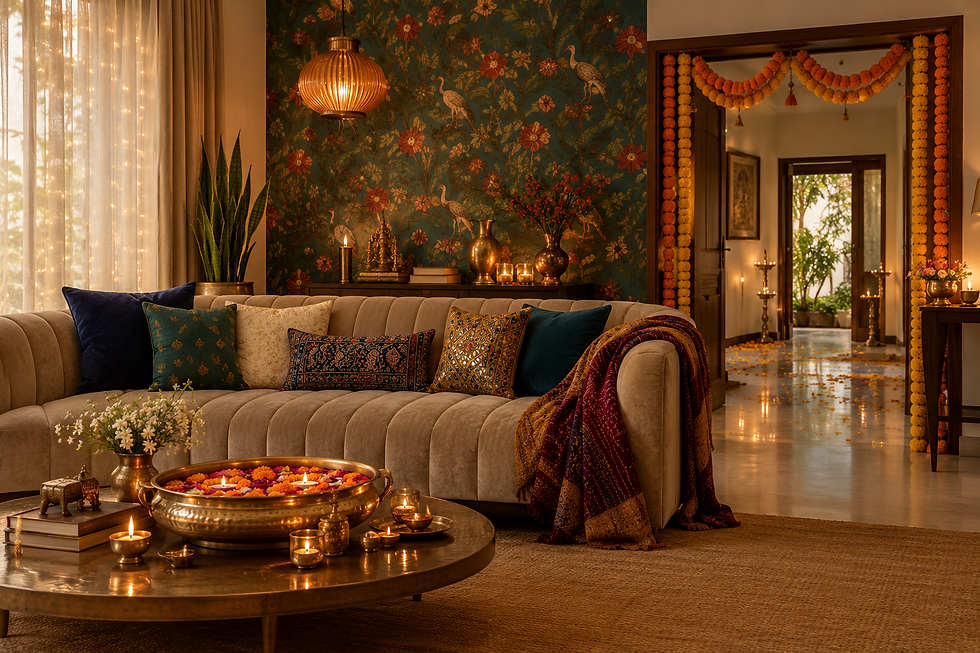
Once the ancestors have been called, the mood of the evening changes. Diyas appear on balconies, and along the edges of rooftops, the lanes are filled with the smell of ghee and burnt jute. Plates of sweets travel between neighbours' doors, and children spill out into the street. For one young woman who grew up there, the evening has always had a particular shape.
"Diwali back home always had its own rhythm. Mom would be in the kitchen making her signature bara ghugni and payasam, while Dad lounged in front of the TV, stepping in whenever one of us needed a hand. Lining up the diyas along the balcony and the roof was strictly my job. I'd always pause for a minute just to look out: the whole street glowing with string lights, kids running around with phuljhadis, the smell of firecrackers in the air. We would swap plates of sweets with the neighbours, put on our new clothes, and head outside so Dad could set off the chakras and snake crackers. There was an effortless warmth and laughter everywhere. Honestly, those simple evenings are what I miss the most." - From the archive of Biswajeeta, Odisha
Bara and ghugni are two separate dishes, usually served together: crisp urad dal vadas and a spiced curry of dried yellow peas. Both are everyday street food in Odisha, but on Diwali they are made at home. With them comes payasam, rice cooked slowly in milk until soft and creamy, and a fixture of almost every Odia celebration.

The doorstep, waiting
The older ritual lives on for her through her mother's stories.
"It's for guiding the souls of our ancestors by lighting the kaunria kathi. When I was living at home, my grandparents were still alive. After they passed away, I've heard Mom talk about it, but I've never witnessed it."
Many traditions survive this way, through stories rather than practice. A mother describes the ritual, her daughter listens, and the knowledge is kept.
Every person is a living archive, so are you.