
Sweets from the Royal Kitchens
Updated: Oct 24
The desserts India's courts gave us, and how they found their way to every festive table.
I. A Book of Delights
Sometime around the year 1500, in the hilltop city of Mandu, a sultan who had grown tired of war decided to spend his remaining years on pleasure. Ghiyath Shah of Malwa handed the affairs of state to his son, Nasir Shah, who would later complete the book, and turned his attention to gardens, music and, above all, the table. The result is one of the most enchanting manuscripts to survive from medieval India: the Ni'matnama, the Book of Delights, now kept in the British Library.

Its pages are painted in lapis and gold. In them, the sultan sits beneath a canopy while women attendants grind spices, stir cauldrons and pour sherbets. Between the miniatures run recipes: for samosas, for scented drinks, for sweetmeats perfumed with rosewater and camphor. It is, quite possibly, the first great cookbook of the subcontinent, and it reads less like a manual than a love letter to appetite. The Ni'matnama tells us something every royal kitchen in India would later confirm. In the courts of this country, sweetness was never an afterthought. It was a language of hospitality, a measure of power and, very often, an art.
II. The Emperor's Ice
By the late 16th century, the Mughal court had turned the kitchen into an institution. Abul Fazl's Ain-i-Akbari, the great chronicle of Akbar's reign, describes an imperial kitchen run like a ministry, with a superintendent, a treasurer, tasters and storekeepers, and every dish sealed before it reached the emperor.
It also records something remarkable for a land of such heat: ice and snow, carried down from the mountains to cool the emperor's water and sherbets.

From that luxury of cold, and from the Persian tradition of sweetened, thickened milk, comes the lineage of kulfi: dense, slow-frozen, packed into conical metal moulds and sealed shut. Food historians still debate exactly when kulfi took its present form, but its spirit is unmistakably courtly: milk reduced patiently over a low fire until it carries the colour of old ivory, scented with saffron and pistachio, and served cold in a country that had to fetch its cold from the Himalayas.

Phirni belongs to the same family of Persian inheritance. Ground rice, milk and sugar, set in small unglazed clay bowls that drink a little of the moisture and lend the dessert a faint, earthen breath. It is a simple thing, and that is precisely the point. Royal cooking at its best was never only about extravagance. It was about restraint, patience and the perfect handling of very few ingredients.
III. Lucknow, and the Art of Slowing Down
If the Mughals built the grammar of the royal kitchen, the Nawabs of Awadh wrote its poetry.
In 18th and 19th century Lucknow, the khansamas and rakabdars (the cooks and specialist garnishers of the court) competed in refinement the way poets competed in verse. Dishes were judged not only by taste but by delicacy, surprise and wit. The city's most famous culinary legend, retold for generations, holds that during the famine of 1784 Nawab Asaf-ud-Daula commissioned the Bara Imambara partly to give his people work, and that great cauldrons of food were sealed and left to cook slowly to feed the labourers. Whether every detail of the story is true matters less than what it reveals: in Awadh, slowness itself became a technique, and dum (the sealed, patient cooking of a covered pot) became an ethic.

That ethic shaped Lucknow's sweets too: zarda, golden rice glistening with saffron, ghee and dried fruit; and the many quiet variations on milk and bread that would travel far beyond the city. In 1856, when the British annexed Awadh, the last Nawab, Wajid Ali Shah, was exiled to Metiabruz on the edge of Calcutta. He brought with him his musicians, his poets and his cooks. Calcutta has been eating a little like Lucknow ever since.
IV. The Nizam's Table
Further south, the Deccan courts were writing their own sweet history. In Hyderabad, the kitchens of the Nizams turned humble ingredients into ceremony. Double ka meetha (slices of bread fried in ghee, soaked in saffron-laced milk and finished with nuts) is the city's cousin of the shahi tukda, the 'royal piece', whose very name announces its pedigree. The bread itself, double roti, was a later arrival, and that is part of the charm: a palace dessert built from the most ordinary loaf.
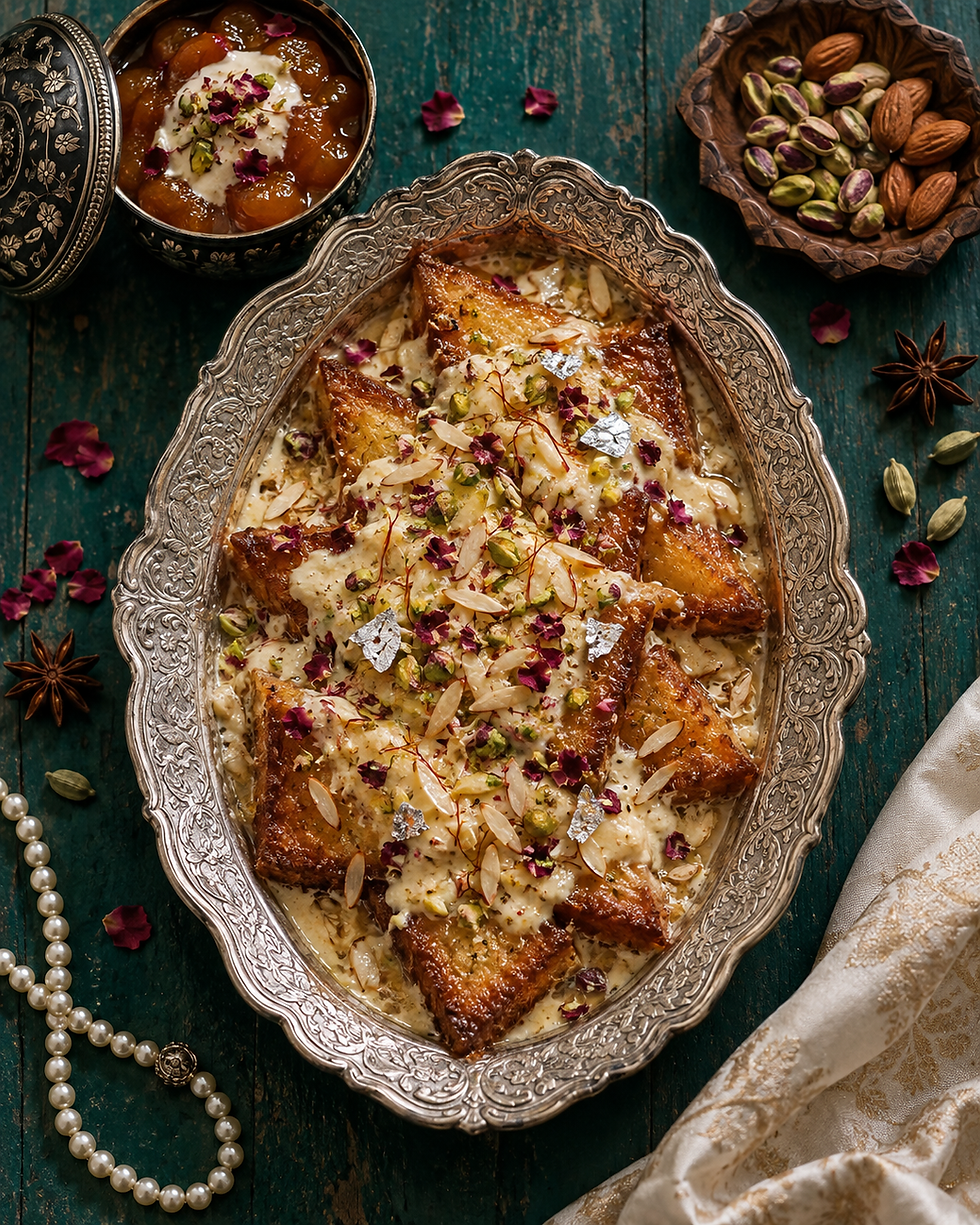
Then there is qubani ka meetha, a deep amber compote of dried apricots, stewed until soft and jammy, often crowned with cream or almond. The apricots came from far away, from Afghanistan and Central Asia along old trade routes, and to this day the dish remains a fixture of Hyderabadi wedding feasts. To taste it is to taste distance, and the long reach of a court that looked both north and west for its pleasures.
V. Born in a Palace Kitchen
Not every royal dessert came from Persia. In the palace of Mysore, during the reign of Krishnaraja Wadiyar IV in the early twentieth century, a cook named Kakasura Madappa is said to have improvised a new sweet from gram flour, ghee and sugar. Asked its name, he called it simply Mysore paka, 'paka' meaning a sweet made with sugar syrup. Madappa's descendants still run a sweet shop in the city, and the story, whatever embellishment it has gathered, is a lovely one: a dish invented for a maharaja that became, within a century, a sweet carried home in boxes by ordinary families across the south.

It is a reminder that the royal kitchen was also a workshop of invention: a place where a cook with enough skill and courage could create something entirely new, and where the new could become tradition within a single lifetime.
VI. Named after a Lady
Even the colonial court left its sugared mark.
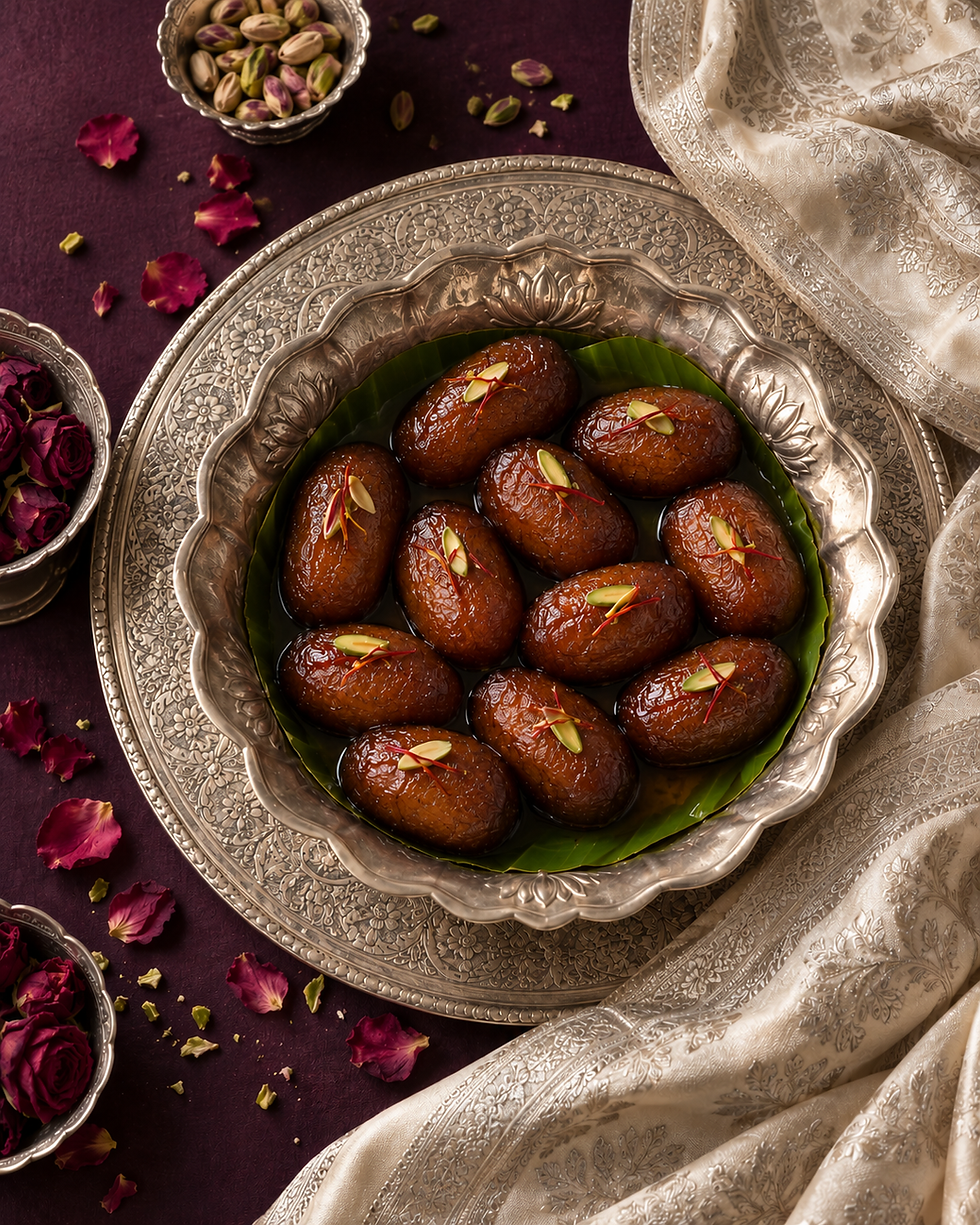
In Calcutta, the confectioner Bhim Chandra Nag is said to have created a special sweet for Lady Canning, wife of the first Viceroy of India, around the late 1850s. Deep-fried, soaked in syrup and darker than a gulab jamun, it was named in her honour, and Bengali tongues soon turned 'Lady Canning' into ledikeni. The sweet survives today in Bengal's mishti shops, a small edible footnote to an empire, quietly reclaimed by the city that made it.
What happened to all these sweets once the courts fell silent?
They did what the best of India's traditions always do: they moved. The khansamas, rakabdars and halwais who had served kings set up shops, cooked for weddings, trained apprentices and took their recipes into the bazaars. A dessert once reserved for a sultan's table became the sweet you queued for before Eid, the box you carried to a neighbour's door on Diwali, the bowl of phirni set out to cool on a winter evening.
Today, a sheer khurma stirred on Eid morning, a plate of shahi tukda at a family dinner, a tin of Mysore pak opened on a festival afternoon: each of these carries a small inheritance. We rarely think of it as royal. We simply think of it as ours. And perhaps that is the truest measure of a royal kitchen's legacy. Not the gold leaf, or the rosewater, or the snow carried down from the mountains, but the fact that, centuries later, its sweetness still finds its way home.


Comments