
The Earth Remembers: Tribal Craft Traditions of Eastern India
Before ink met paper, before history found its archivists, stories were etched into earth, woven into fabric, and shaped by hand. In the eastern reaches of India, across lush plateaus, river valleys, and mineral-rich highlands, tribal communities have long practiced a language of making that predates the written word. Their crafts are not merely objects of beauty; they are repositories of memory, cosmology, and survival.
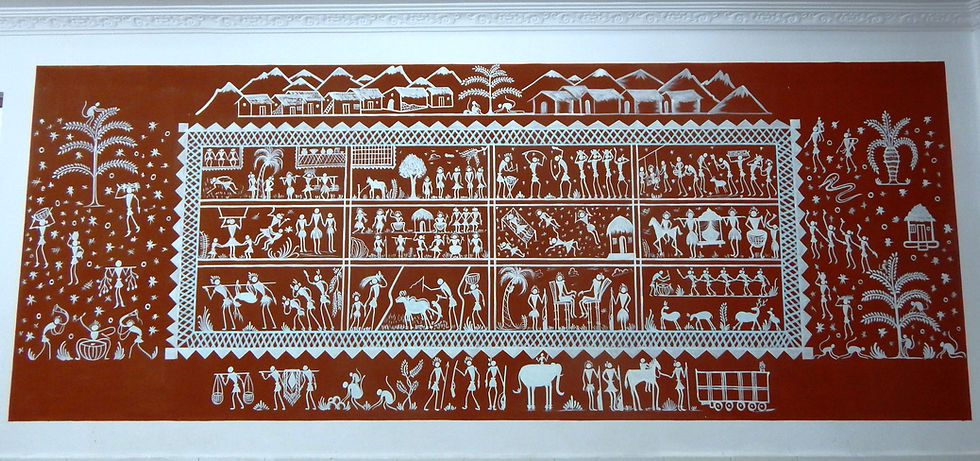
In the undulating landscapes of Odisha, the Saura community paints its inner worlds onto walls and scrolls in a ritual art form known as Saura Painting. Composed of rhythmic lines and stylized human forms, these sacred murals are less decorative flourish and more spiritual cartography - mapping myths, harvests, births, and the delicate contract between humans and the natural world. Traditionally created to invoke prosperity and protection, each composition reads like a visual hymn.

Travel eastward into Jharkhand and West Bengal, and the glint of hammered metal reveals another legacy: Dhokra. Among the subcontinent’s oldest metal-casting traditions, Dhokra employs the ancient lost-wax technique - a method traced by scholars to the metallurgical brilliance of the Indus Valley Civilisation. The process is exacting, almost alchemical. Beeswax is shaped by hand, encased in clay, fired until it yields, and finally filled with molten brass. What emerges are elongated figurines, ritual vessels, and animal forms, each bearing the tactile honesty of the maker’s touch. No two pieces are identical; variation is not flaw, but signature.
Further into the temple towns and artisan villages of Odisha and West Bengal, the narrative arts unfurl in exquisite detail through Pattachitra painting. Rendered on treated cloth and palm leaf, these intricate works are composed with mineral pigments, natural brushes, and astonishing patience. Mythology flows across the surface in disciplined lines and jewel-toned palettes, episodes from the epics, celestial beings, sacred flora, and temple lore meticulously framed within ornamental borders. Each painting is both scripture and spectacle, where storytelling becomes devotion and surface becomes sanctum.

What distinguishes tribal craft is not simply technique, but worldview. Making is inseparable from living. Utility is aesthetic. Ornament is narrative. Knowledge flows orally, experientially, communally - carried in gesture rather than manuscript. The artisan is historian, philosopher, and ecologist at once.
Colonial ethnographers once catalogued these traditions as curiosities; modern markets often repackage them as rustic luxury. Yet beyond classification and commerce lies their truest significance: continuity. In village courtyards and shaded workshops, hands still move with inherited precision. Fire still tempers metal. Earth still yields pigment. Form still follows memory.
To encounter the tribal crafts of eastern India is to witness culture in its most elemental state - shaped slowly, held collectively, and sustained across centuries not by preservation alone, but by practice.
The earth remembers. And through these crafts, so do we.


Comments