
The Colours India Already Knew
Before Pantone. Before the swatch book. Before the grid.
Long before a Swiss company assigned numbers to the spectrum, India was already fluent in colour. Not in the language of codes and calibrations, but in the language of gods and rivers, of monsoons and minerals, of roots pulled from the earth at the right hour of the right season. The subcontinent did not merely use colour. It understood it with a depth that was simultaneously sacred, scientific and sensory.
In the caves of Ajanta, painters ground malachite and lapis lazuli into pigment and pressed the lives of the Buddha onto wet plaster with a certainty that has outlasted fifteen centuries. In the dye vats of Rajasthan and Gujarat, craftsmen read colour the way astronomers read the sky, by experience, by inheritance, by a knowledge passed hand to hand across generations without ever being written down. The Arthashastra of Kautilya, written in the fourth century BCE, listed regulations for dyers and cloth merchants. The Sanskrit texts of Ayurveda named colours by their healing properties. The poets of the Sangam age gave Tamil words to shades of the sea that have no equivalent in any European tongue.
Colour, in India, was never decorative first. It was devotional, medicinal, political, ecological. Saffron marked renunciation. Red marked the threshold between a woman's father's home and her husband's. Indigo financed empires and broke the backs of the farmers who grew it. The absence of colour, the white of widowhood, carried its own unbearable weight.
What follows is not a colour chart. It is a small archaeology. Nine colours, each with a name that contains its own origin, its own history, its own place in the long and intricate conversation between this land and the people who have lived upon it.
These are the colours India already knew.
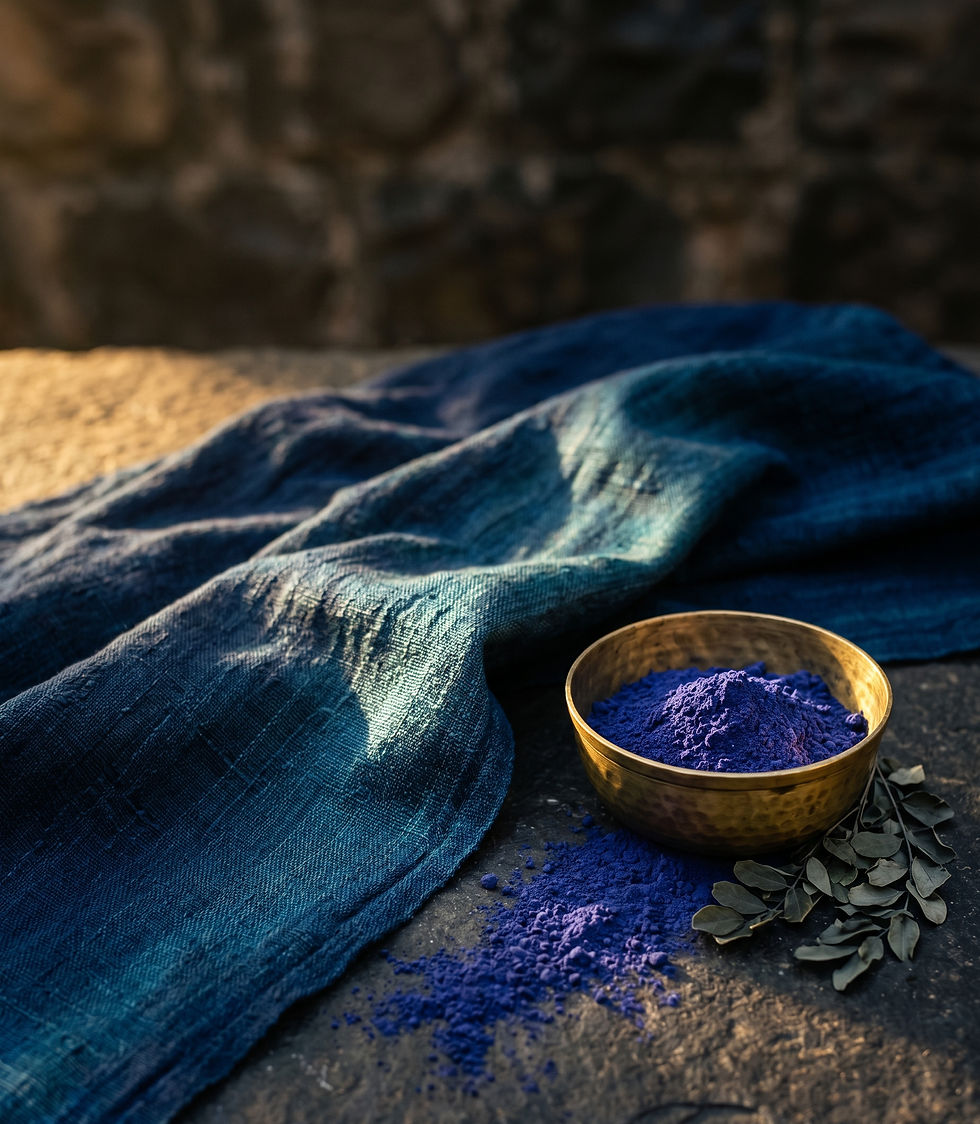
The colour of the sky the moment before it decides to rain. Neel is indigo, but to call it merely indigo is to strip it of everything it carried. It arrived in Europe under the name of a country. It funded wars. It broke the backs of farmers. In the hands of a dyer in Bagh or a block printing artisan in Bagru, however, it was none of these things. It was simply the most faithful colour in the world, the one that deepened with every wash, that gave itself more completely with age, that did not fade so much as settle, slowly, into something richer than it began.

Somewhere between sage and celadon, between the first flush of a mango leaf and the pale belly of a river fish, lives Subzkishmish. Named for the skin of a dried grape, translucent and faintly gold-green, it is a colour that rewards stillness. You must look at it twice before you understand what it is doing. The Mughals chased this quality of green obsessively, Jahangir catalogued his emeralds like verses, Shah Jahan had them engraved and Subzkishmish holds that longing inside it, the desire for a colour that will not quite be caught.

Poison and pigment in the same breath. Haritala, orpiment, was a mineral yellow of arsenic trisulphide gleaming, slightly toxic, and so luminous on the page that the illuminated manuscripts of the Deccan and the Mughal atelier practically hummed with it. Painters handled it with respect, ground it with care, used it knowing it demanded caution. The name comes from hari, meaning yellow-green, and tala, meaning the surface of the earth. It was the colour of turmeric fields seen from above, of ancient stone walls where lichen had not yet won.

If Haritala was yellow in its mineral severity, Haldi is yellow in its most intimate form. Turmeric. The root that stains everything it touches and never entirely leaves. In India, Haldi precedes every beginning: it is applied to the skin before a wedding, offered to the gods before a prayer, stirred into milk in the blue hour before dawn. Its yellow is not decorative. It is protective. Ancient. The colour of thresholds. On cloth, it appears warm and slightly muted, as though it remembers being a root, remembers the dark of the earth.

There is a colour that belongs to the road. To wandering, to renunciation, to the long particular freedom of having nothing. Gerua, also called Gairika, is the reddish-brown of iron oxide pulled from the earth, the pigment that colours the robes of ascetics and the walls of temples and the floors of old haveli courtyards in equal measure. It is the colour of dried riverbanks, of the dust that rises behind a bullock cart in the heat of May. Colonial architects reached for it too, painting their bungalows this colour as though proximity to the earth might make them belong to it. It is, at once, the most humble and the most sacred colour in the Indian palette.

Before synthetic red arrived in its loud, confident modernity, there was Aal. Extracted from the root of Morinda citrifolia, the Indian mulberry, Aal produced a red that was earthy and warm, never shrill. The weavers of Kanjeevaram knew it well. It is the red of temple corridors, of a dancer's feet stained with alta, of a copper vessel catching afternoon light. Not a colour that announces itself but one that reveals itself, slowly, like a memory surfacing through still water. Against a deep cream or a raw ivory, Aal becomes everything.

An empire's obsession given a name. Mughal Green is not one green but a family of them, all of them leaning towards the cool and the mineral, towards jade and tourmaline and the inside of a pistachio. It is the green of the Charbagh, the paradisiacal garden laid out in four quarters to mirror heaven. It is the green of Qur'anic verse painted on a white marble wall. It is what you see when you look at a pietra dura inlay up close and realise that paradise was always architectural here, always a colour someone chose and cut and set by hand into stone.

There is no colour more democratic in India than Gulaal. It belongs to everyone and no one. Powder pink, powder rose, the colour that hangs in the air above a Holi crowd like a benediction, that settles on hair and cloth and eyelashes and refuses to be solemn about any of it. Gulaal is joy in its most physical form, colour as touch, as celebration, as the deliberate undoing of all that is kept clean and careful. In the quieter context of a dyer's hand or a festival thali, it is the softest possible pink: dry, dusty, the memory of a petal rather than the petal itself.
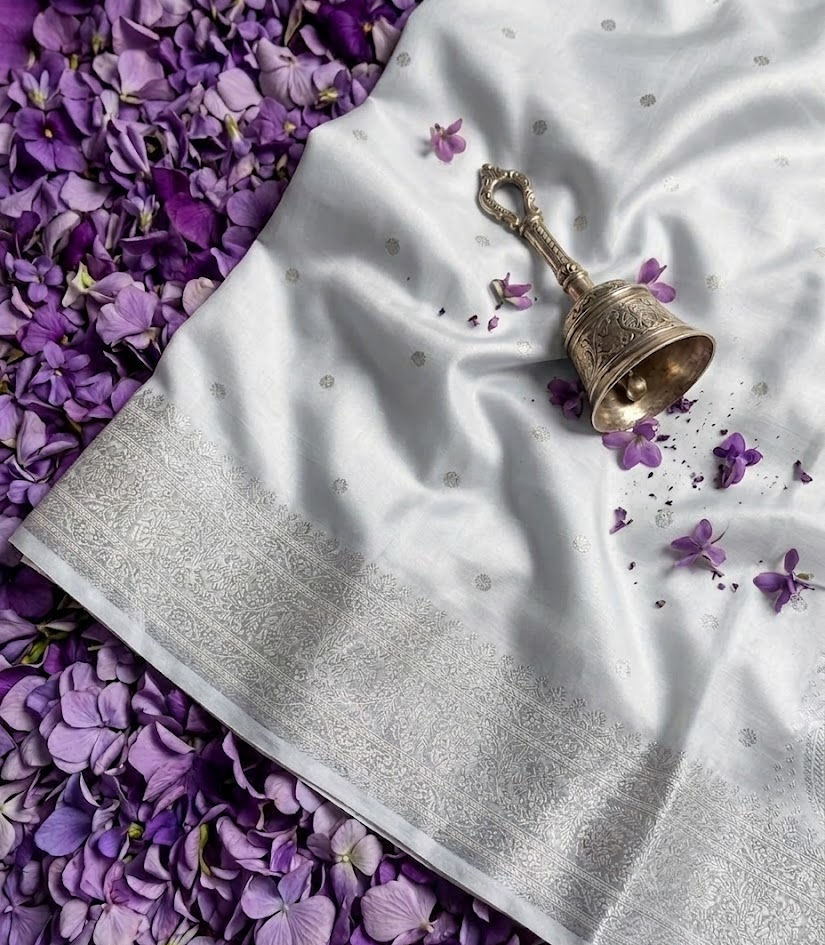
And then, white. But not the white of absence. Kapursafed, the white of camphor, is the white of sanctity. Of smoke. Of something that exists briefly and leaves a fragrance in its place. In a kapursafed Banarasi saree woven in pure katan silk, the colour is not empty, it carries the weight of every occasion for which it was preserved, every ceremony in which white meant purity rather than mourning, every morning ritual in which a flame was held to a tablet of camphor and a prayer was said in the light of it burning away. This is not white as a background. This is white as the most considered colour of all.
Nine colours. Nine origins. A palette that never needed a number to know itself.


Comments