
Parchin Kari: A Study in Permanence
Stand close enough to the cenotaph inside the Taj Mahal and the eye stops trusting itself. A flower rendered in stone should read as flat, as image. But the inlay bends light differently across each petal, because each petal is not paint but a separately cut, separately polished piece of stone, fitted into the marble with a tolerance so fine the joint disappears entirely.
This is parchin kari, literally "driven in," the Mughal refinement of a technique the Florentines had perfected only decades earlier as pietra dura, hard stone, inlaid and polished until image and surface become the same plane. Whether the technique arrived in India through direct instruction from Italian craftsmen or evolved in parallel from an older, indigenous tradition of softer-stone inlay remains genuinely unsettled among scholars.
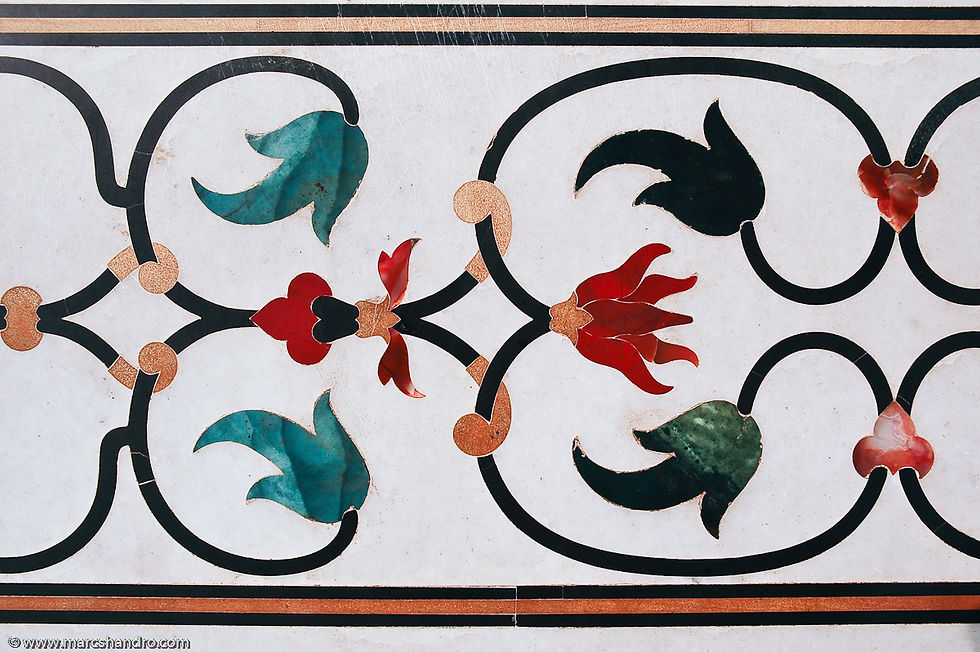
The historical record shows both currents running at once, most vividly in the tablet of Orpheus set into the Red Fort's Diwan-i-Aam, a piece close enough to Florentine work that it is now widely believed to be an actual import rather than a local imitation. What is not in dispute is who did the labour once Shah Jahan made the technique his own. Contemporary accounts name the artisans of the Taj Mahal by their specific roles: sang-tarash, the stonecutters; gul-tarash, the flower-carvers; parchinkars, the inlayers themselves. Historical record suggests the majority were Hindu craftsmen from Kannauj, working a decoratively Persian and doctrinally Islamic building into being.
The 17th-century poet Kalim wrote that the flowers inlaid into that marble would remain in perpetual bloom, a small, exact description of what the technique actually achieves: a living, seasonal image, fixed by the hardest material available into a permanence no real flower could survive.

Mother-of-pearl belongs to a related but distinct lineage, older than parchin kari by millennia and geographically wider in its wandering. Shell inlay appears in Sumerian tombs dated to roughly 4,500 years ago, and the craft found its most concentrated expression under the Ottomans, where it earned its own dedicated title, sedefkar, mother-of-pearl craftsman, a profession significant enough that Istanbul once held over 100 dedicated workshops. In Damascus, marquetry combining mother-of-pearl with wood and bone became a tradition stretching back 2,000 years, exacting enough that a single inlaid cabinet, often made as a dowry piece, could take a craftsman a full year of work.

The material's own physical properties are what make all of this labour worth the time: mother-of-pearl, or nacre, is built from microscopic layers of aragonite platelets, thin enough that light passing through them diffracts and interferes with itself, producing the shifting, colour-without-pigment iridescence no dye or paint can replicate. The craft that turns raw shell into finished inlay follows a sequence unchanged in its essentials for centuries. Nacre-rich shell is selected from pearl oyster or abalone and judged for thickness and colour, cut into thin sections with fine saws, then shaped piece by piece against a drawn pattern, usually geometric or floral, before being set into a ground of wood, stone, or marble with the same invisible precision parchin kari demands of cut stone.
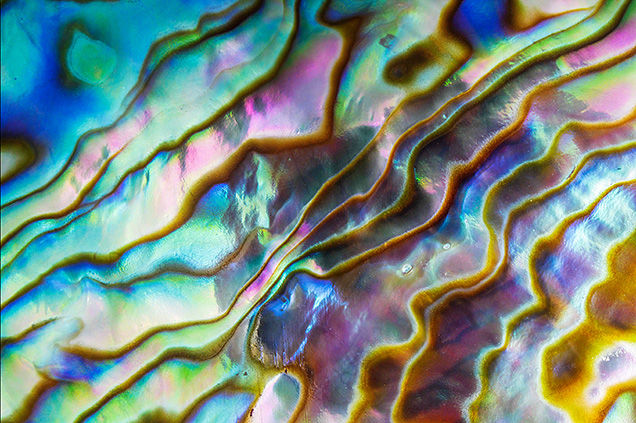
In India specifically, the material found an additional, distinctly local existence. From the 16th century, Gujarat and Sindh became major centres not merely of consumption but of export: luxury cabinets and caskets overlaid with mother-of-pearl, manufactured locally and sent outward along trade routes to be admired elsewhere, an indigenous industry rather than a borrowed one.
On Mughal architectural surfaces themselves, mother-of-pearl was frequently worked alongside marble and semi-precious stone, the two inlay traditions sharing the same walls, related by technique and by the same underlying design logic that governs nearly all Islamic architectural ornament: a geometric, modular precision, visible equally in the infinite repeat of a girih pattern, the perforated stone lattice of a jaali screen, and the fitted, jewel-toned surface of a parchin kari panel. All three are versions of the same ambition: mathematics made luminous, hard material coaxed into a pattern that reads, against all physical sense, as alive.
That ambition has not stayed confined to walls and cabinets. This year, the Delhi-based designer Rimzim Dadu presented a couture collection, INLAE, built entirely on the same inheritance. Individually cut pieces of mother-of-pearl were engineered directly into the structure of a textile rather than applied to its surface, so that a material with no natural memory of softness is made, through months of technical development, to move with a body the way parchin kari and sedefkar work were never able to move with a wall.
It is not an homage so much as a continuation: the same hard, luminous material, still being driven into a surface by hand, still asking the same old question a Mughal inlayer or an Ottoman sedefkar would have recognised immediately, whether stillness is really the only form permanence is allowed to take.


Comments