
The Aangan On Screen - What Indian Cinema Knew About the Courtyard
There is a kind of architectural knowledge that does not live in textbooks. It lives in the body, in the way a person slows upon crossing a threshold, in how light changes quality when a roof is removed and sky is returned. For centuries, the domestic life in India was organised around this knowledge. The house was not built from the outside in, but, from the open centre outward. The courtyard came first. Everything else followed. Indian cinema, at its most attentive, remembered this.

Long before sustainability became a design philosophy, Indian filmmakers were drawing on the courtyard as their most reliable instrument of emotional precision. Not as a picturesque remnant of a pre-modern world, not as visual shorthand for tradition, but, as a space with its own grammar, its own demands, its own capacity to hold what sealed rooms could not contain and open streets could not dignify. This is a reading of what six directors across six regions of India understood about a space that, once lost, is not easily recovered.
The Space That Came Before the Story
To understand why the aangan works so powerfully on screen, one must first understand what it was before cinema claimed it. The courtyard house is among the oldest continuously inhabited spatial forms in South Asia. The planned cities of the Indus Valley Civilisation were organised around it. Each dwelling folded inward, with the open centre providing light, ventilation, and a shared domestic heart that no single room could replicate. This was not aesthetic preference. It was ecological intelligence: the courtyard moderated heat, harvested rain, drew air through deep stone plans, and made the enormous task of collective domestic life manageable without glass, electricity, or mechanical cooling.
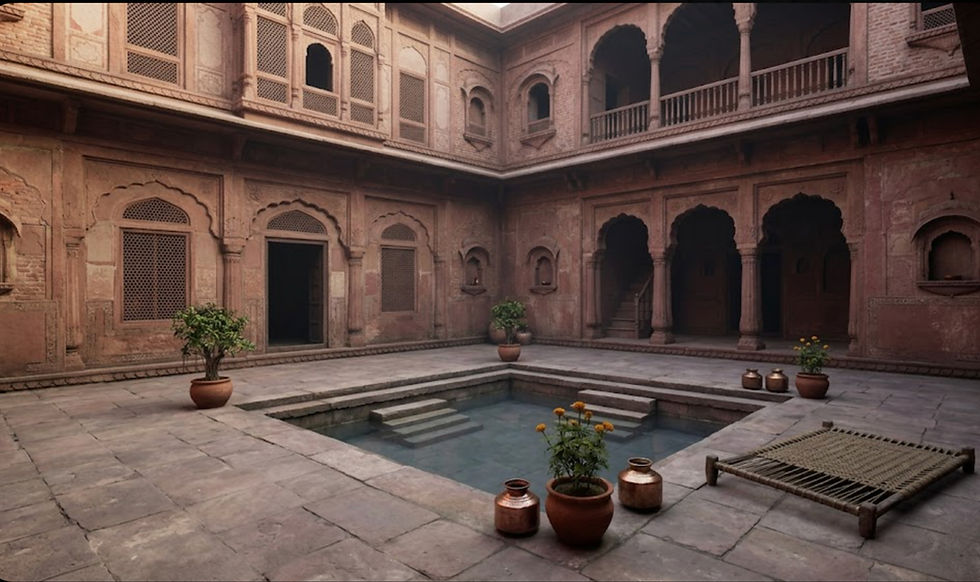
But the courtyard's longevity cannot be explained by climate alone. What sustained it across centuries and regions, from Rajasthan and Bengal to Tamil Nadu and Kerala, was its social intelligence. The courtyard was the part of the house that belonged simultaneously to everyone and to no one. It absorbed work and ritual, festivity and grief, surveillance and sanctuary. No other domestic space held that range without either imposing formality or dissolving into chaos. It is precisely this quality, the courtyard's refusal to be only one thing that made it irresistible to filmmakers. When a story demands a space where private feeling and social expectation must share the same air, where the sky remains present even as the walls close in, the courtyard is the only architecture honest enough for the task.
Six Films, Six Regions, One Space
The Rajasthani haveli courtyard is one of the most formally elaborate domestic spaces in Indian architectural history. Screened by jali, shaded by deep chhatris, punctuated by arched niches that hold oil lamps, it is a space that filters light rather than admitting it directly and creating an interior world that is simultaneously rich and withheld, present and slightly elsewhere. Palekar builds his film around this spatial quality. The courtyard in Paheli is not a stage for action but a container for suspension, for the particular condition of a woman whose domestic life has been vacated, who inhabits a space that is architecturally full and emotionally emptied. The Rajasthani courtyard, with its layered screens and its filtered desert light, is the only architecture capable of making that suspension feel real rather than metaphorical. It holds enchantment because it was always, in some sense, enchanted.

The Bengali aristocratic household organised itself around the thakurdalan, an inner courtyard that was as much ceremonial as domestic, a space where the family's social standing was performed as much as it was inhabited. Columns, terraces, and layered galleries surrounded a centre that held prayer, assembly, and the formal movements of household life. Light entered from above, but it entered into a space already weighted with expectation. Sanjay Leela Bhansali draws on this architecture not for spectacle but for inevitability. The thakurdalan courtyard is the spatial form of a social world in which feeling cannot be purely private where emotion is always, in some register, a performance before the household. This is what gives the film its particular quality of architectural tragedy: the sense that the building itself is complicit in what befalls its inhabitants, that the courtyard's beauty and its rigidity are one and the same thing.

In Tamil domestic and institutional architecture, the open interior functions as an assembly space. A place governed by position, hierarchy, and the social grammar of who stands where in relation to whom. The courtyard in the South Indian tradition is not casual. It is charged with the protocols of caste, kinship, and public life; it is where a household makes its social claims visible and where those claims are tested against the presence of others. Mani Ratnam's film is a study in how private persons are shaped into public figures, and the courtyard is its most precise geographical instrument. It is the threshold between the intimate and the performed, the space where a man's domestic self and his political self must occupy the same frame. In a film about the manufacture of charisma and the costs of visibility, the courtyard's particular quality, its refusal to fully separate the personal from the witnessed becomes the architecture the story cannot do without.

The Gujarati haveli courtyard is a particular spatial proposition: it is an interior that never fully withdraws from the life of the house. Ringed by carved balconies, animated by the movement of multiple generations, ventilated by a sky that is always present overhead, the courtyard was historically designed not for solitude but for collective inhabitation. Privacy in such a house was not architectural, it was negotiated, impermanent, constantly subject to revision. Bhansali builds his entire film on this spatial truth. The haveli courtyard is the engine of the world he creates. The space through which music, festivity, desire, and domestic authority all circulate together without segregation. What the Gujarati courtyard gives the film is the condition of witnessed life: a domestic world in which emotion is never entirely one's own, because the architecture was never designed to permit it.

In the rural Indian home, the courtyard is neither decorative nor ceremonial. It is the working centre of the house. The place where grain is dried, where children are looked after, where the rhythms of agricultural life move in and out of the domestic world without friction. The boundary between inside and outside was never the point. The courtyard dissolved that boundary by design, making the house porous to season, community, and the accumulated texture of shared daily life. Gowariker uses this spatial logic as the film's quiet argument. The village courtyard embodies a way of inhabiting the world that is fundamentally relational. One that places the individual not at the centre of domestic space but within a web of reciprocal obligation and presence. It is the sense of belonging, and the film understands that belonging cannot be thought or decided. It must be lived.

The Kerala tharavad operates according to a spatial logic unlike any of the preceding examples. It is not exuberant like the Gujarat aangan not ceremonial like the Bengali thakurdalan, not screened and suspended like the Rajasthani haveli. It is dense with memory, lineage, ritual, and the accumulated weight of a matrilineal household order that organised inheritance, authority, and belonging through the house itself rather than through individual ownership. The tharavad courtyard is the centre of that density. It is where the house gathers itself, where ancestral presence is architecturally felt, where the living cohabit with the weight of the dead in a manner that is neither mystical nor sentimental but simply structural. In Aaraam Thampuran, this space gives authority its texture not as abstraction but as something that can be entered, stood within, and submitted to. The courtyard is the house's memory made spatial, and in a film about inheritance and legitimacy, it is the most honest architecture available.

The Pattern
Set the six films against one another and what emerges is not coincidence but principle.
The regional idiom changes profoundly. The open exuberance of the Gujarati courtyard has nothing visually in common with the ancestral density of the Kerala tharavad, and the screened enclosure of the Rajasthani haveli speaks a different spatial language from the ceremonial thakurdalan of Bengal. Yet, each filmmaker reaches for the courtyard at the same moment: when the story requires a space that is neither fully private nor fully public, neither sealed against the world nor surrendered to it. The courtyard offers what no other domestic space can. A centre that gathers without capturing, that exposes without humiliating, that opens upward even as the walls hold in. Each one of these directors understood, instinctively or deliberately, that the most emotionally loaded moments of Indian domestic life have always required sky.
What We Lost When We Closed the Sky
The courtyard has largely disappeared from contemporary Indian domestic architecture. The apartment block eliminated it structurally. The premium placed on air-conditioned enclosed space made it economically illegible and the progressive privatisation of domestic life made its social logic seem antiquated. Within a few decades, the space that had organised Indian households for millennia became a heritage feature, something restored in boutique hotels, photographed for design magazines, but hardly inhabited as daily life.
What departed with the courtyard was not simply ventilation or light. It was a way of understanding what a home is for.
The courtyard proposed that the domestic world was not purely private. The household held responsibilities to air, to sky, to the collective rhythms of the people living within it. It proposed that the most important passages of a life deserved to happen under an open sky not because this was romantic, but because it was honest. The sky reminded the house of its scale. The house, in turn, gave the sky a frame.
Indian cinema carried this knowledge long after the architecture had surrendered it. That is why the courtyard remains so emotionally immediate on screen. It is not nostalgia the audience is responding to, but recognition. The body's quiet acknowledgement of a spatial intelligence it has not entirely forgotten, even if the buildings that once held it are mostly gone.
The aangan is not a ruin. It is a proposition. And as cities grow hotter, rooms grow smaller, and the sky recedes further from daily life, it may be a proposition worth inhabiting again. Not as heritage, but as sense.

Comments